
Chicken Noodle Soup With Lemon Recipe
This post contains affiliate links. As an Amazon Associate I earn from qualifying purchases.
This dish looks and tastes like it costs $40 at a restaurant. The ingredients cost under $10. I’m talking silky cream, tender shredded chicken, perfectly al dente noodles, and that BRIGHT lemon finish that makes people ask, “Where did you learn to cook like this?” The secret? Simple techniques, quality basics, and the kind of wisdom you develop when you’re cooking for yourself and your community in New York City on a realistic budget. If you’re looking for other comforting, affordable staples, check out my best beef noodle recipe—another crowd-pleaser that won’t empty your wallet.
Restaurant-Quality Chicken Noodle Soup With Lemon Recipe for Under $10 (No Shortcuts on Flavor)
I created this recipe during my early years as a dietitian in Manhattan, when I was living on an actual budget but REFUSING to eat poorly. I’d watch people order creamy chicken noodle soups from upscale delis for $15–$18 per bowl, and I thought: “I can make this better, faster, and for less than the cost of one fancy coffee.”
What struck me most was how my friends and family reacted when I served it. They didn’t taste “budget.” They tasted sophistication. They tasted care. They tasted the lemon brightening every spoonful, the herbs working in harmony, the cream hitting at exactly the right moment. That’s when I realized something powerful: eating well on a budget isn’t about deprivation—it’s about INTENTION.
This recipe teaches you how to layer flavor, build richness smartly, and respect your money while respecting your palate. It’s proof that the most impressive meals come from understanding fundamentals, not fancy ingredients.
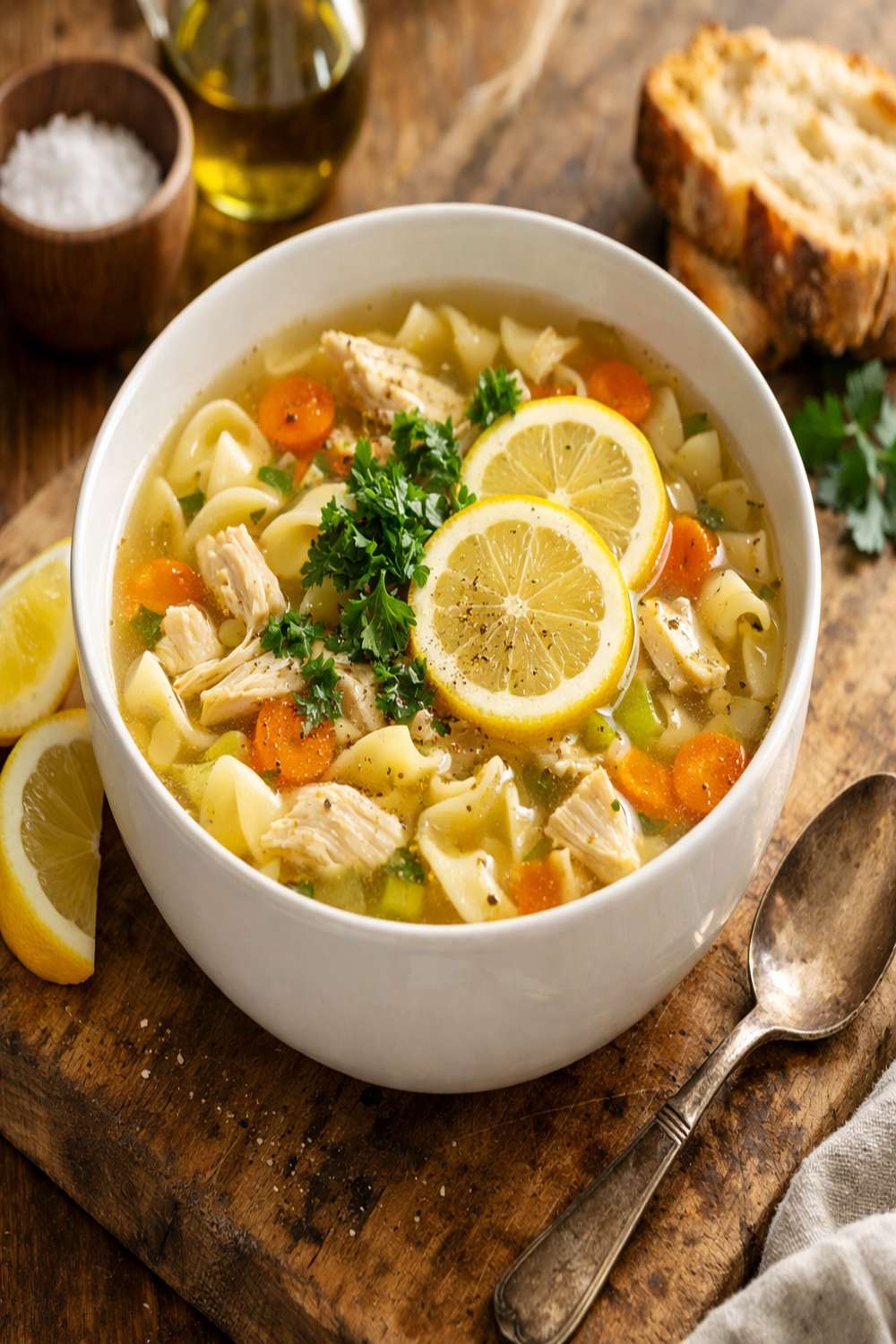
The Real Cost Breakdown
Let me give you the honest numbers. I priced this at a standard NYC grocery store (where prices run HIGH) and a budget-friendly chain. Your costs may vary by location, but this shows you the framework.
- Boneless, skinless chicken breasts (500g) – $5.50 (buy when on sale, freeze ahead)
- Extra-virgin olive oil (2 tbsp) – $0.40 (buy in bulk, lasts months)
- Brown onion – $0.35
- Garlic, fresh (1 tbsp minced) – $0.25
- Carrot – $0.30
- Celery (2 stalks) – $0.40
- Unsalted butter (2 tbsp) – $0.35
- All-purpose flour (35g) – $0.10
- Chicken stock (1 liter) – $1.50 (buy no-sodium, on sale)
- Water – free
- Dried thyme, oregano, paprika, sea salt, black pepper – $0.50 (pantry staples you already have)
- Vermicelli noodles or angel hair pasta (150g) – $0.60
- Zucchini – $0.80
- Heavy cream (250ml) – $1.80
- Parmesan, freshly grated (100g) – $2.00
- Fresh parsley (2 tbsp) – $0.40
- Fresh lemon juice (2 tbsp) – $0.30
TOTAL COST: $15.75 for the entire recipe (feeds 4 generously)
That’s $3.94 per serving. A single bowl at a restaurant? $14–$18. You’re saving $10–$14 PER PERSON and getting a fresher, better product.
Smart Shopping Tips for This Recipe
- Buy chicken on sale and freeze it. Most supermarkets mark down chicken 30–40% when it’s within 2–3 days of the sell-by date. Freeze it immediately. Use it within 3 months. This single habit can cut your protein costs in half.
- Buy stock in bulk when it’s on sale. Stock is heavy and expensive to ship, so buy 4–6 cartons when your store runs a promotion (usually around major holidays). Store in a cool pantry. Homemade stock is cheaper if you save chicken bones, but quality boxed stock at sale price beats most homemade in terms of time-to-money ratio.
- Splurge on ONE thing: the lemon. Buy fresh lemons over bottled juice every single time. Bottled juice tastes metallic and muted. Fresh lemon juice is what makes this soup shine. Everything else? You can absolutely save on. Store-brand cream, generic parmesan (block, grated at home), basic dried herbs.
- Buy vegetables that are IN season. Zucchini is cheapest summer through early fall. In winter, swap it for diced potato or mushroom (both under $1). Carrots and celery are inexpensive year-round—they’re your budget heroes.
- Get parmesan as a block and grate it yourself. Pre-shredded parmesan costs 40–50% more and contains anti-caking agents that affect melting. A $5 block yields enough for 8–10 servings. Microplane grater = $8 one-time investment.
The Ingredients
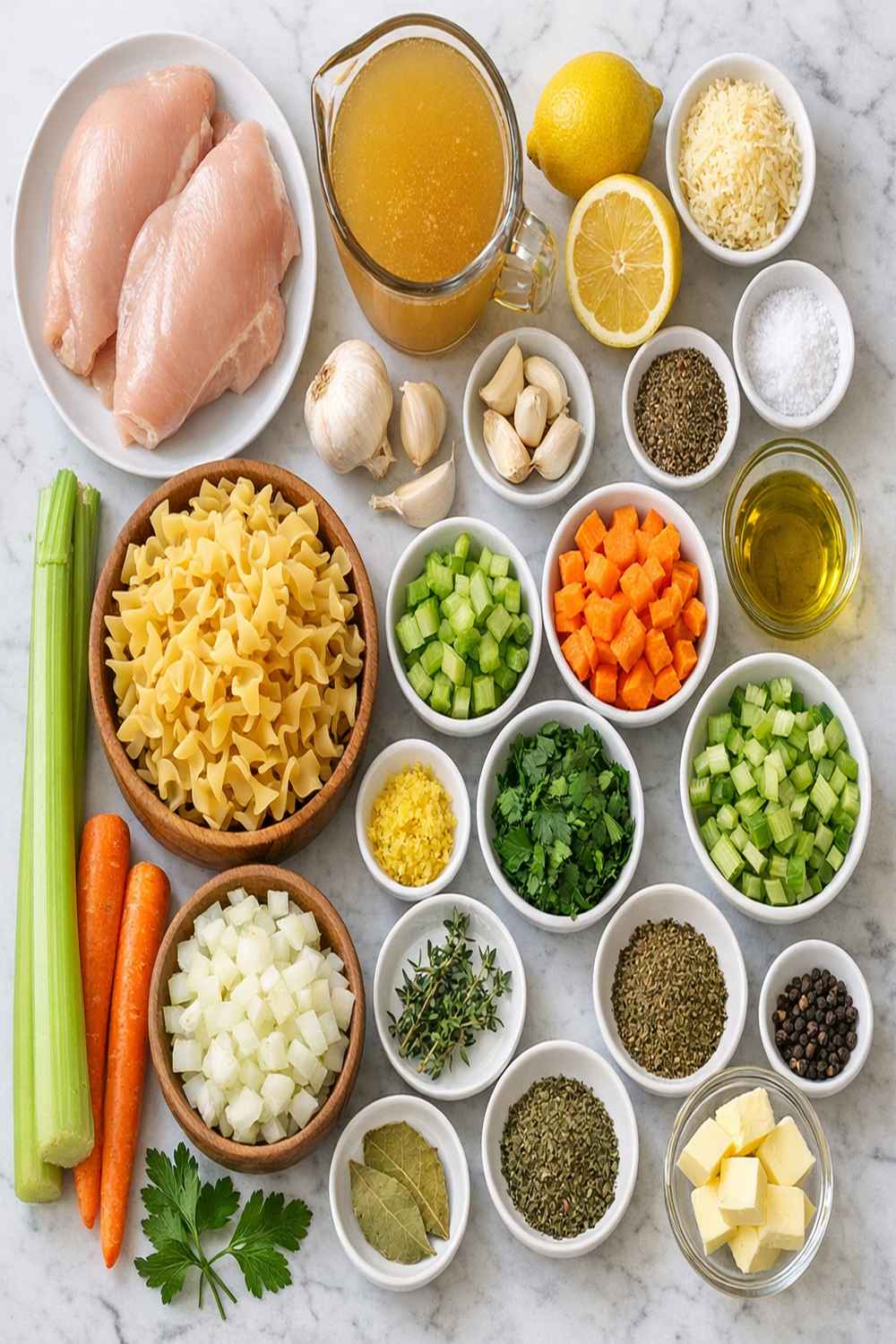
Every ingredient earns its place and its cost. Nothing here is filler. Nothing here is fancy for fancy’s sake. This is the formula for a soup that tastes like you’ve been cooking all day, built in about 35 minutes. Makes 4 generous servings.
- 35 grams all-purpose flour (spooned and leveled, this creates the roux that thickens beautifully)
- 1 teaspoon dried thyme (a key aromatic, use the dried form for this step)
- 2 tablespoons fresh flat-leaf parsley, finely chopped (adds brightness and final garnish appeal)
- ½ teaspoon freshly cracked black pepper (freshly cracked tastes 10x better than pre-ground)
- 150 grams vermicelli egg noodles or angel hair pasta (thin noodles cook fast and don’t get mushy)
- 500 milliliters water (dilutes the stock to the right intensity)
- 1 brown onion, finely diced (the base of all depth)
- 1 zucchini (medium, finely diced—adds lightness and freshness)
- ½ teaspoon sea salt flakes (kosher or sea salt dissolves better than table salt)
- 2 tablespoons extra-virgin olive oil (use a mid-range brand, not your most expensive)
- 1 tablespoon freshly minced garlic (fresh garlic, not jarred—the difference is real)
- 1 teaspoon dried oregano (adds another layer of herbal complexity)
- 1 carrot, finely diced (adds sweetness and body)
- 2 tablespoons unsalted butter (use unsalted so you control sodium)
- ¼ teaspoon freshly cracked black pepper plus extra for serving (more pepper goes in the broth)
- 1 liter chicken stock (use low-sodium—you add salt yourself this way)
- 250 milliliters heavy cream or whipping cream (full-fat, not half-and-half—it needs to hold up to heat)
- 2 tablespoons fresh lemon juice (squeezed from one large lemon, this is the soul of the dish)
- 2 celery stalks, finely diced (the unsung hero of balanced flavor)
- 1 teaspoon sweet paprika (adds warmth and subtle sweetness)
- 500 grams boneless, skinless chicken breasts (cut in half horizontally to create thinner steaks—this helps them cook evenly and quickly)
- 100 grams freshly grated Parmesan cheese plus extra for serving (not pre-shredded)
How to Make Chicken Noodle Soup With Lemon Recipe Without Breaking the Bank
This is smart cooking. Not rushed cooking. Not compromised cooking. You’re going to build this soup in layers, and every layer matters. The result? People will think you went to culinary school. (You didn’t. You just understood the fundamentals.)
Step 1: Season and Sear the Chicken
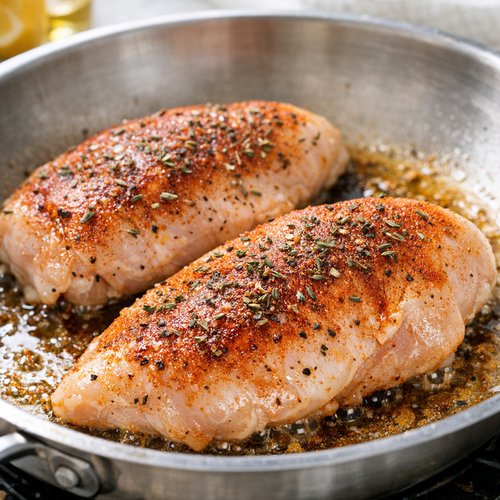
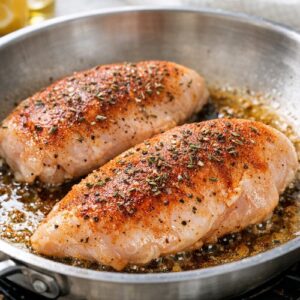
Pat your chicken breasts dry with a paper towel—this is NON-NEGOTIABLE for a good golden crust. Sprinkle both sides generously with paprika, dried thyme, salt, and black pepper. Be generous. This is your only chance to flavor the chicken itself.
Heat your olive oil in a large, heavy-bottomed pot or stockpot over medium-high heat. You want it HOT but not smoking. Once it shimmers, place the chicken in the pan. DO NOT MOVE IT. Let it sit for exactly 2 minutes. Flip once. Cook for another 2 minutes on the second side until you see a deep golden-brown crust forming.
The chicken will still be raw in the center—and THAT’S CORRECT. You’re not cooking it through yet. You’re building flavor through the Maillard reaction (the browning that creates complexity). Remove it to a clean plate. This step takes 5 minutes and costs you basically nothing in oil, but it’s the difference between “fine soup” and “memorable soup.”
Step 2: Build the Aromatic Base
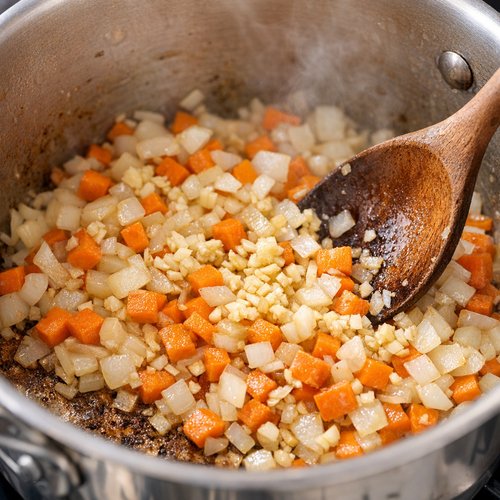
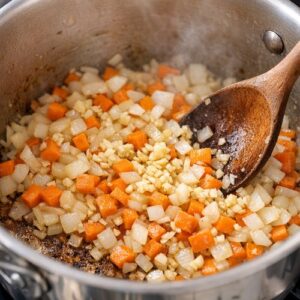
Keep that same pot over medium heat (don’t wash it—all those flavorful brown bits stuck to the bottom are GOLD). Add your diced onion, garlic, carrot, and celery directly to the pot. Stir constantly for 3–4 minutes until everything softens and becomes fragrant. You’ll notice the vegetables start releasing their moisture and the pan gets even more flavorful. This aromatic base is why professional soups taste professional.
This step costs you about $1.30 and teaches your body what REAL soup building smells like. Bonus: your kitchen will smell incredible.
Step 3: Make Your Roux (The Thickening Agent)
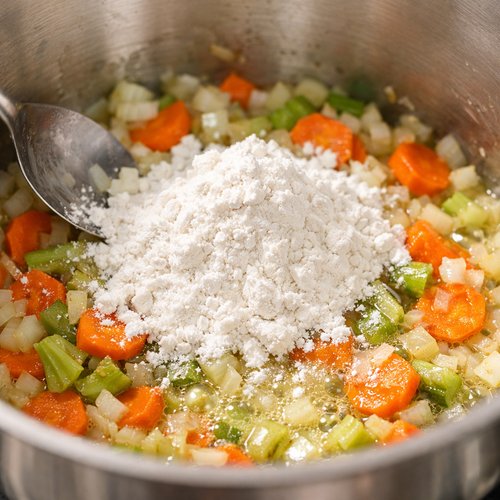
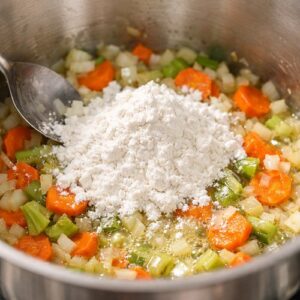
Add butter to the vegetables and let it melt completely—about 30 seconds. The moment it’s melted, add your flour all at once. HERE’S WHERE PRECISION MATTERS: stir constantly for 1 full minute. You’re creating a roux, which is a 1:1 ratio of fat to flour that acts as a thickening agent. Don’t skip the stirring. Don’t cut it short to 30 seconds. A full minute ensures the flour cooks out its raw taste and becomes part of the sauce, not gritty flour-flavored soup.
The mixture will look like wet sand, then gradually like a thick paste. That’s EXACTLY what you want. SAFETY WARNING: Roux is hot. Don’t touch it. Don’t lean over it. Keep kids and pets away from the stove during this step.
Step 4: Add Liquid and Build the Broth
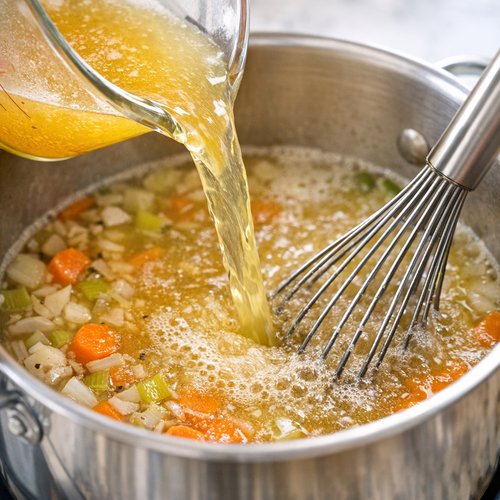
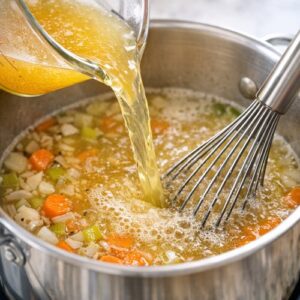
Pour in your chicken stock and water slowly while whisking constantly. This prevents lumps from forming. WHISK, don’t stir with a spoon. Whisking incorporates the roux evenly into the liquid. Once all liquid is added, add dried thyme, oregano, and the additional ¼ teaspoon black pepper.
Bring the soup to a simmer over medium heat—you want small, gentle bubbles, not a rolling boil. Once simmering, return your seared chicken to the pot. It’ll sink below the surface. Cover the pot BUT leave the lid slightly ajar. This allows steam to escape (otherwise you’ll end up with too much liquid). Lower heat to medium-low and cook for exactly 10 minutes. The chicken finishes cooking gently in the broth, staying juicy instead of tough.
Step 5: Shred the Chicken
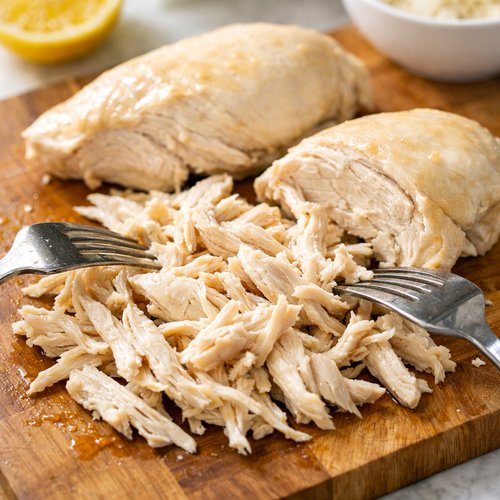
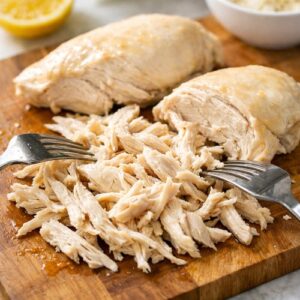
After 10 minutes, remove the chicken to a clean cutting board or plate. Let it rest for 1 minute—this keeps it from drying out as you handle it. Using two forks (one in each hand), pull the chicken apart into shreds about ½-inch thick. The chicken should be fully cooked and white throughout with NO pink. If there’s any pink, return it to the broth for another 2–3 minutes.
Set the shredded chicken aside on a plate. Don’t add it back yet—you’ve got two more steps to go.
Step 6: Add Pasta, Vegetables, and Cream
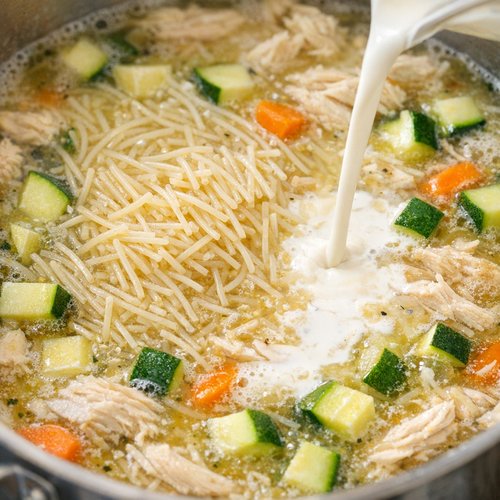
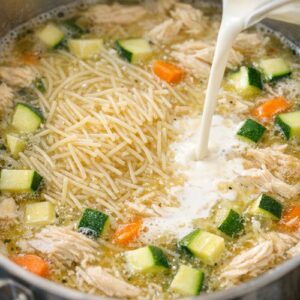
To the simmering broth, add your vermicelli noodles and diced zucchini. Cook uncovered for 2–3 minutes. Vermicelli cooks FAST (much faster than thicker pasta shapes), so watch it carefully. You want the pasta to be just tender—not mushy, not al dente to the point of being crunchy. This is where experience matters: it should have a tiny bit of resistance but be fully cooked.
Once the pasta looks cooked, reduce heat to low. Pour in your heavy cream slowly while stirring. Don’t use half-and-half or light cream—the fat content matters for texture and richness. Stir constantly so the cream distributes evenly and doesn’t pool or separate.
Step 7: Finish and Season
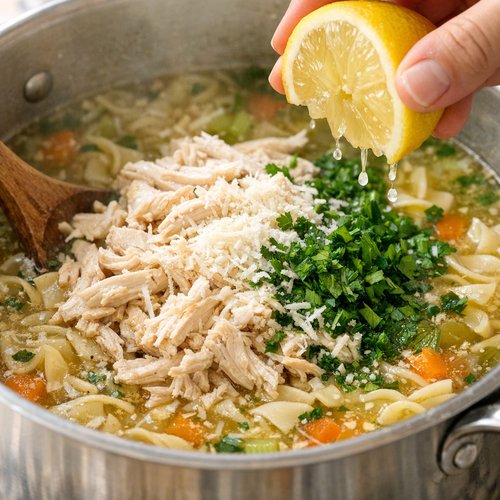
Turn the heat completely off. Add your shredded chicken back to the pot along with the freshly grated Parmesan, fresh parsley, and lemon juice. Stir gently to combine everything. The residual heat will warm the chicken back through without cooking it further.
THICKNESS CHECK: Taste your soup. Does it feel too thick? Add a splash of water or stock and stir. Too thin? Make a quick slurry by mixing 1 tablespoon flour with 2 tablespoons cold water, then whisk it into the hot soup. This is a pro move that saves soups from being under- or over-thickened.
Step 8: Serve and Celebrate
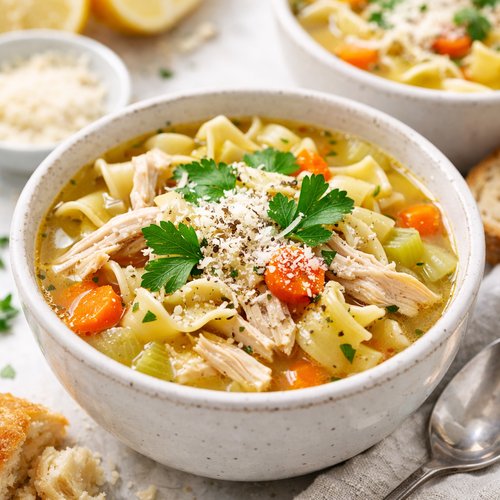
Ladle into bowls. Top with a crack of fresh black pepper, a pinch of Parmesan, and a few fresh parsley leaves. Serve immediately while it’s hot and creamy. Your $3.94-per-serving soup looks like a $16 restaurant dish. It tastes better. And you made it in your own kitchen, understanding every single ingredient that went into it.
Expert’s Nutritional Tip: Why the Lemon Matters More Than You Think
As a registered dietitian, I can tell you that lemon juice isn’t just about flavor—it’s about bioavailability and nutrient absorption. The citric acid in fresh lemon enhances the absorption of iron from the chicken and vegetables. Additionally, lemon adds brightness without sodium, allowing you to use less salt while perceiving MORE flavor. The soup feels luxurious because your taste buds are getting sophisticated signals from multiple flavor dimensions—fat (cream), umami (Parmesan and chicken stock), herbs, and bright acidity (lemon). This is why a squeeze of lemon transforms good soup into memorable soup. Don’t skip it. Don’t substitute bottled juice. Fresh lemon is the most impactful dollar you’ll spend in this recipe.
Make-Ahead Guide: Meal Prep Like a Professional
Up to 3 days ahead: Dice your onion, carrot, celery, and zucchini. Store in separate airtight containers in the fridge. Grate your Parmesan and store in an airtight container. Chop your parsley and store with a damp paper towel inside an airtight container to keep it fresh.
Up to 1 day ahead: Complete Steps 1–4 of the recipe (sear the chicken, build the aromatics, make the roux, add the liquid). Let the soup cool to room temperature, then refrigerate in an airtight container. The flavor actually deepens overnight. When you’re ready to serve, reheat gently over medium-low heat, then proceed with Steps 5–8.
Freezer storage (up to 3 months): Make the soup through Step 5 (after you’ve shredded the chicken), but DO NOT add cream, Parmesan, parsley, or lemon. Cool completely, then freeze in airtight containers (leave ½ inch headspace). When reheating, thaw overnight in the fridge, then warm gently over medium-low heat. Add cream, Parmesan, parsley, and lemon fresh when serving. The reason? Cream can separate during freezing, and fresh herbs taste best when added fresh.
How to Stretch This Recipe Further
- Stretch it to 6 servings instead of 4: After Step 4, add an extra 250ml of water and 150g additional pasta. You’re diluting slightly, but the aromatics and chicken still season the entire pot beautifully. Cost per serving drops to $2.62. Perfect for families or meal prep.
- Transform leftovers into a lighter pasta dish: Leftover soup can be thinned slightly and served over cooked pasta as a light sauce. Or thicken it further by simmering uncovered and serving it as a creamy chicken-noodle casserole situation (top with crushed crackers and broil for 2 minutes). One batch of soup = three different meals.
- Batch cook for the freezer: Triple this recipe and freeze in portions. On busy weeknights, you have a homemade, fresh-tasting soup ready in 5 minutes (thaw and reheat). This is how you avoid takeout spending. You’re investing 45 minutes once to save money and time repeatedly.
Budget Substitutions That Don’t Sacrifice Quality
- Heavy cream → Evaporated milk (unsweetened): Costs 30% less and creates almost the same richness. The texture is slightly less velvety, but flavor is virtually identical. Use the same amount (250ml). Pro tip: evaporated milk is shelf-stable, so you can buy it on sale and keep it indefinitely.
- Fresh Parmesan (block) → Domestic Parmesan (block): Skip the imported Parmigiano-Reggiano if budget is tight. Domestic Parmesan (often from Wisconsin or California) costs half as much and tastes 90% as good. Still grate it fresh—pre-shredded is still a ripoff.
- Vermicelli egg noodles → Regular egg noodles or broken spaghetti: Same cooking time, same texture, same cost. If you have pasta at home, use it. This soup is forgiving. Don’t buy a special ingredient if you already have similar pasta.
- Fresh zucchini → Frozen mixed vegetables (peas and carrots): During winter when zucchini is $2–$3 per pound, buy frozen mixed vegetables for $1.50. You lose some textural interest, but nutritionally and flavor-wise, it’s solid. You’re saving money where it matters.
Common Mistakes to Avoid (So You Get It Right the First Time)
Mistake 1: Skipping the sear step. People want to save time and just throw raw chicken in the broth. STOP. The 5-minute sear creates flavor complexity that’s impossible to replicate. Plus, it only adds 5 minutes. The soup is better. Do it.
Mistake 2: Cooking the pasta too long. Vermicelli is delicate. If you cook it for 4–5 minutes instead of 2–3, it becomes mushy and falls apart into the broth, turning everything starchy and gluey. Set a timer. Check it at 2 minutes. It should still have a touch of resistance to the bite.
Mistake 3: Adding cream at the wrong temperature. If you add cold cream to a rolling boil, it can break (separate into streaks). Always add cream at a gentle simmer, and always add it slowly while stirring. This is how you get that silky, integrated richness.
Mistake 4: Forgetting the lemon or adding it too early. Lemon added during cooking can become bitter. Fresh lemon juice added at the very end (after heat is off) tastes bright and lively. Add it last. Taste as you go. You can always add more lemon, but you can’t take it out.
Seasonal Variations: How to Adapt This Recipe
Spring: Swap zucchini for diced asparagus (add at the same time as the pasta). Add fresh dill instead of or alongside the parsley. Squeeze in some fresh lime juice instead of lemon for a different brightness.
Summer: Make as written. This is zucchini season. Maximize it. Add fresh corn kernels along with the zucchini for sweetness. Fresh herbs (basil, parsley, dill) are cheap and abundant.
Fall: Swap zucchini for diced butternut squash (add 2–3 minutes earlier so it has time to soften). Add a pinch of nutmeg or sage along with the thyme. The soup becomes earthier and more warming.
Winter: Replace zucchini with diced potato or mushroom. Add a splash of white wine after the roux (let it simmer for 1 minute before adding stock) for deeper flavor. Consider using dried sage instead of fresh thyme for a more robust, warming taste.
Can I Store Chicken Noodle Soup With Lemon Recipe?
Yes. Refrigerate in an airtight container for up to 4 days. The flavor deepens as it sits—day 2 is actually better than day 1. Reheat gently over medium-low heat, stirring occasionally, until warmed through. Don’t boil it aggressively or the cream can separate.
For freezing: Make the soup through the shredding step (Step 5), but omit cream, Parmesan, parsley, and lemon. Cool completely, then freeze in airtight containers for up to 3 months. Thaw overnight in the fridge, reheat gently, then add cream, Parmesan, parsley, and lemon fresh. This prevents texture breakdown and keeps fresh flavors actually fresh.
IMPORTANT SAFETY NOTE: If the soup develops an off smell, visible mold, or appears slimy, discard it immediately. Cream-based soups need careful storage to avoid bacterial growth.
Nutrition Information
Per serving (based on 4 servings): Approximately 520 calories | 32g protein | 28g fat (11g saturated) | 38g carbohydrates | 2.5g fiber | 890mg sodium | 18mg iron | 420mg calcium.
Why this matters: One bowl of this soup provides 64% of your daily protein needs, 23% of your daily iron (crucial if you’re vegetarian or someone who doesn’t eat meat often), and 42% of your daily calcium. The fiber comes from the vegetables; the protein from the chicken; the healthy fats from the cream and olive oil. According to USDA dietary guidelines, this is a nutritionally balanced meal—not just a side soup. Pair it with bread or a salad, and you’ve got a complete dinner for under $4.
For folks watching sodium: This recipe contains moderate sodium (890mg per serving, or about 37% of the daily limit). If you need to reduce it further, use no-sodium stock and reduce added salt in the seasoning step. The lemon will compensate with brightness.
What Can I Serve With Chicken Noodle Soup With Lemon Recipe?
This soup is rich enough to be a complete meal on its own, but here are budget-friendly companions that make it feel like a restaurant experience.
- Crusty bread or garlic bread: A $2 baguette from the bakery section, sliced and toasted with a rub of garlic and olive oil. Dip it in the soup. Peak comfort food. Cost: $0.50 per serving.
- Simple green salad: Arugula or mixed greens with a lemon vinaigrette (lemon juice, olive oil, Dijon mustard, salt, pepper). The acidic, peppery salad cuts through the richness of the soup beautifully. Cost: $1 per serving.
- Roasted vegetables on the side: Broccoli or Brussels sprouts tossed with olive oil, salt, and pepper, roasted at 425°F for 15 minutes. Adds contrast and nutrition. Cost: $0.75 per serving.
- Grilled cheese sandwich (if you’re feeding kids): A classic pairing. Two slices of bread, cheese, butter, griddled until golden. Dip it into the soup. Everyone happy. Cost: $1.25 per serving.
If you want other comforting main-dish ideas, my beef stew recipe in the slow cooker is another budget-friendly stunner that feels fancy but costs less than takeout.

Chicken Noodle Soup With Lemon Recipe
Ingredients
Method
- Pat your chicken breasts dry with a paper towel—this is NON-NEGOTIABLE for a good golden crust. Sprinkle both sides generously with paprika, dried thyme, salt, and black pepper. Be generous. This is your only chance to flavor the chicken itself. Heat your olive oil in a large, heavy-bottomed pot or stockpot over medium-high heat. You want it HOT but not smoking. Once it shimmers, place the chicken in the pan. DO NOT MOVE IT. Let it sit for exactly 2 minutes. Flip once. Cook for another 2 minutes on the second side until you see a deep golden-brown crust forming. The chicken will still be raw in the center—and THAT'S CORRECT. You're not cooking it through yet. You're building flavor through the Maillard reaction (the browning that creates complexity). Remove it to a clean plate. This step takes 5 minutes and costs you basically nothing in oil, but it's the difference between "fine soup" and "memorable soup."
- Keep that same pot over medium heat (don't wash it—all those flavorful brown bits stuck to the bottom are GOLD). Add your diced onion, garlic, carrot, and celery directly to the pot. Stir constantly for 3–4 minutes until everything softens and becomes fragrant. You'll notice the vegetables start releasing their moisture and the pan gets even more flavorful. This aromatic base is why professional soups taste professional. This step costs you about $1.30 and teaches your body what REAL soup building smells like. Bonus: your kitchen will smell incredible.
- Add butter to the vegetables and let it melt completely—about 30 seconds. The moment it's melted, add your flour all at once. HERE'S WHERE PRECISION MATTERS: stir constantly for 1 full minute. You're creating a roux, which is a 1:1 ratio of fat to flour that acts as a thickening agent. Don't skip the stirring. Don't cut it short to 30 seconds. A full minute ensures the flour cooks out its raw taste and becomes part of the sauce, not gritty flour-flavored soup. The mixture will look like wet sand, then gradually like a thick paste. That's EXACTLY what you want. SAFETY WARNING: Roux is hot. Don't touch it. Don't lean over it. Keep kids and pets away from the stove during this step.
- Pour in your chicken stock and water slowly while whisking constantly. This prevents lumps from forming. WHISK, don't stir with a spoon. Whisking incorporates the roux evenly into the liquid. Once all liquid is added, add dried thyme, oregano, and the additional ¼ teaspoon black pepper. Bring the soup to a simmer over medium heat—you want small, gentle bubbles, not a rolling boil. Once simmering, return your seared chicken to the pot. It'll sink below the surface. Cover the pot BUT leave the lid slightly ajar. This allows steam to escape (otherwise you'll end up with too much liquid). Lower heat to medium-low and cook for exactly 10 minutes. The chicken finishes cooking gently in the broth, staying juicy instead of tough.
- After 10 minutes, remove the chicken to a clean cutting board or plate. Let it rest for 1 minute—this keeps it from drying out as you handle it. Using two forks (one in each hand), pull the chicken apart into shreds about ½-inch thick. The chicken should be fully cooked and white throughout with NO pink. If there's any pink, return it to the broth for another 2–3 minutes. Set the shredded chicken aside on a plate. Don't add it back yet—you've got two more steps to go.
- To the simmering broth, add your vermicelli noodles and diced zucchini. Cook uncovered for 2–3 minutes. Vermicelli cooks FAST (much faster than thicker pasta shapes), so watch it carefully. You want the pasta to be just tender—not mushy, not al dente to the point of being crunchy. This is where experience matters: it should have a tiny bit of resistance but be fully cooked. Once the pasta looks cooked, reduce heat to low. Pour in your heavy cream slowly while stirring. Don't use half-and-half or light cream—the fat content matters for texture and richness. Stir constantly so the cream distributes evenly and doesn't pool or separate.
- Turn the heat completely off. Add your shredded chicken back to the pot along with the freshly grated Parmesan, fresh parsley, and lemon juice. Stir gently to combine everything. The residual heat will warm the chicken back through without cooking it further. THICKNESS CHECK: Taste your soup. Does it feel too thick? Add a splash of water or stock and stir. Too thin? Make a quick slurry by mixing 1 tablespoon flour with 2 tablespoons cold water, then whisk it into the hot soup. This is a pro move that saves soups from being under- or over-thickened.
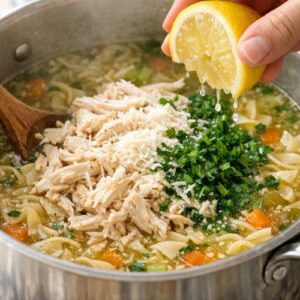
- Ladle into bowls. Top with a crack of fresh black pepper, a pinch of Parmesan, and a few fresh parsley leaves. Serve immediately while it's hot and creamy. Your $3.94-per-serving soup looks like a $16 restaurant dish. It tastes better. And you made it in your own kitchen, understanding every single ingredient that went into it.

Notes
FAQs
Can I use rotisserie chicken instead of raw chicken breasts?
Absolutely. Skip Steps 1–2 (the searing and initial cooking). Use 2 cups shredded rotisserie chicken. Add it directly at Step 6, after the pasta has cooked. This saves 15 minutes and costs roughly the same ($5–$6 for a rotisserie chicken vs. $5.50 for raw breasts). You lose the flavor depth from searing, but you gain speed. Trade-off is worth it on busy nights.
What if I don’t have fresh lemon?
Fresh lemon is really important for this soup—it’s the final brightness that makes it sing. BUT if you genuinely don’t have one, use 1 tablespoon of white wine vinegar instead. It provides acidity and lifts the flavors. Don’t use bottled lemon juice; it tastes chemical and muted. If you can, buy a lemon. It costs $0.30 and transforms the dish.
Can I make this soup dairy-free?
Yes. Replace heavy cream with full-fat coconut milk (250ml). Replace Parmesan with nutritional yeast (2 tablespoons) for umami and cheesy flavor. The soup will taste different (earthier, less traditionally creamy), but it’s delicious. Cost is almost identical. Skip the traditional garnish and top with fresh herbs and a drizzle of olive oil instead.
How do I fix soup that’s too thick?
Add liquid a splash at a time: chicken stock or water (broth) or cream (if you want to keep it rich). Whisk in well. Taste. Repeat until you reach desired consistency. Never add a full cup at once—you’ll overshoot and have to cook it down again.
Can I use gluten-free flour instead of all-purpose flour?
Yes. Use 1:1 gluten-free flour blend (the kind that’s already mixed with xanthan gum). The roux will work identically. The soup will thicken the same way. A few notes: gluten-free flour can absorb slightly more liquid, so you might need an extra tablespoon of water if the soup seems thicker than expected. Also, some people notice a slightly different mouthfeel—not worse, just different. The flavor is unchanged.
More Budget-Friendly Recipes
- Best Chicken Gravy Recipe – A silky, from-scratch gravy that costs $1.50 to make and tastes like it came from a fancy rotisserie restaurant. Perfect with mashed potatoes or over chicken and biscuits.
- Beef Ramen Recipe Easy – A simplified ramen that feeds four people for under $8 total. Rich broth, tender beef, fresh noodles. Restaurant-quality without the $14-per-bowl price tag.
Final Thoughts: Eating Well Doesn’t Mean Spending a Lot
This recipe is proof of something I believe deeply: the most impressive meals come from understanding fundamentals, not from fancy ingredients or complicated techniques. You learned how to sear protein, build aromatics, make a roux, balance flavors with acid and richness, and finish with intention. These are the skills that make every soup, every sauce, every main dish taste professional.
You spent under $4 per serving and under 45 minutes. You now have a dinner that looks like a $40 restaurant dish. More importantly, you understand exactly what went into every spoonful—no preservatives, no mystery ingredients, just real food built with care and intentionality.
This is what eating well on a budget actually means. It’s not deprivation. It’s sophistication. It’s power. Cook this soup. Serve it to people you love. Watch their faces light up. Then tell me about it. Because THAT’S what makes cooking a breeze—knowing you’ve created something meaningful without sacrifice.
Let’s make cooking a breeze!
